Ballet Steps & Concepts - Fundamental Techniques Part 2
Building on the fundamental positions, explore the elegant steps that grace the world's greatest stages. From delicate tendus to spectacular grand jetés, from controlled pirouettes to the seemingly effortless ballon of allegro work, discover the movements that bring ballet to life. Learn the essential concepts that guide every dancer's artistry and technical mastery.
Fundamental Ballet Steps
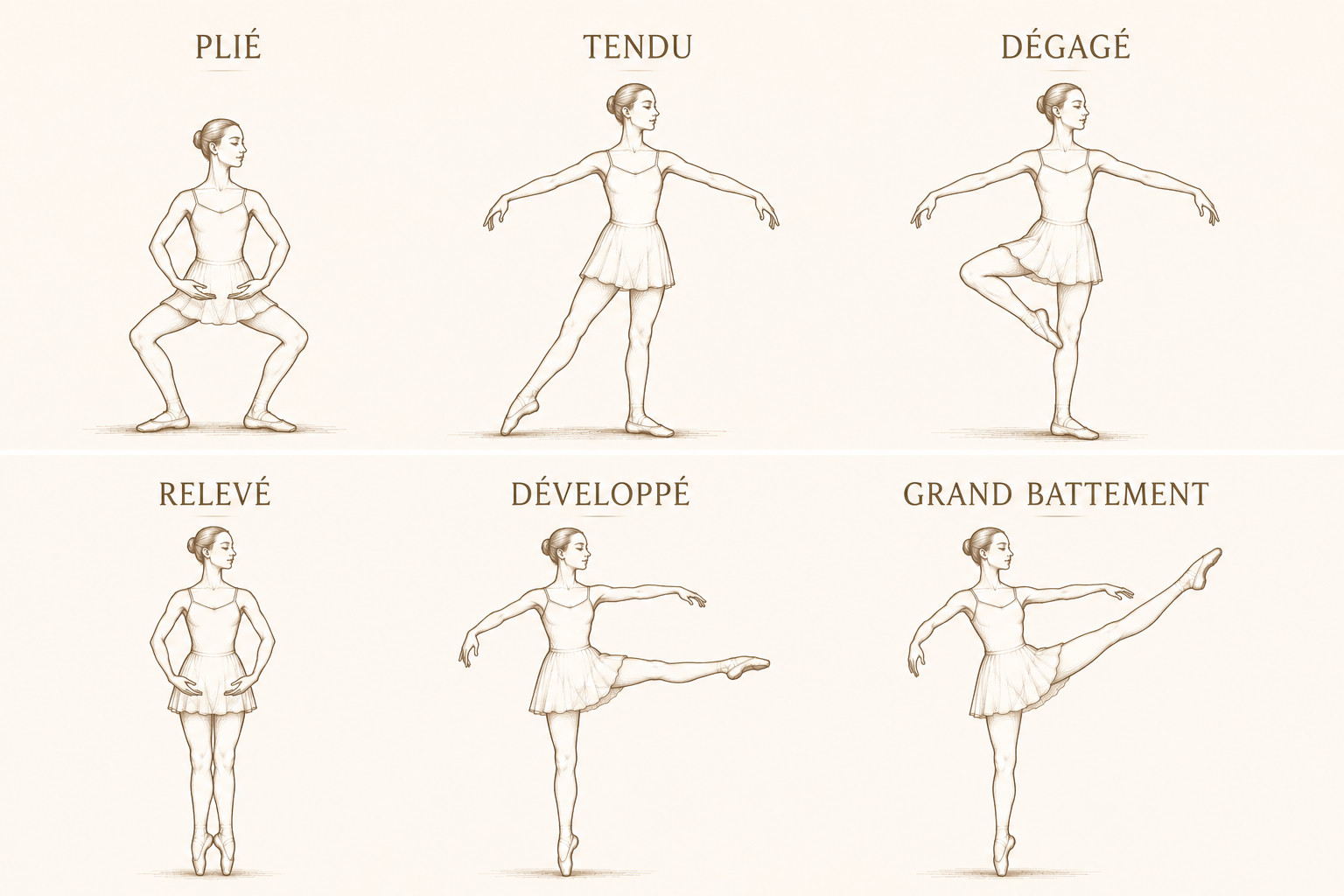
Pliés & Tendus
Plié
Meaning: "Bent"
A bending of the knees with the back held straight and the knees tracking over the toes. Demi-plié (half bend) keeps the heels on the floor, while grand plié (large bend) involves lowering until the thighs are horizontal (except in second position). Pliés are the foundation of all jumping and landing, developing strength and control in the legs.
Tendu
Meaning: "Stretched"
The working foot slides along the floor from a closed position until fully pointed, with the toe remaining on the floor. The leg is fully extended and turned out. Tendus strengthen the feet and legs, improve turnout, and are fundamental to almost every ballet step.
Dégagé
Meaning: "Disengaged"
Similar to tendu, but the pointed foot lifts slightly off the floor (approximately 2-4 inches). The movement is quick and sharp, brushing through a tendu position. Dégagés develop speed and precision in footwork.
Rises & Extensions
Relevé
Meaning: "Raised"
Rising onto the balls of the feet or onto pointe. Can be performed from any position. A smooth relevé involves a continuous rise, while a spring relevé uses a small jump to reach the elevated position. Relevés build strength in the feet, ankles, and calves.
Developpé
Meaning: "Developed"
The working leg is drawn up to the knee of the supporting leg, then slowly extended (developed) to an open position in the air. The movement should be smooth and controlled, showing the unfolding of the leg. Developpés require exceptional strength and control.
Grand Battement
Meaning: "Large beating"
A powerful throwing movement where the working leg is raised as high as possible while keeping both legs straight and hips square. The leg passes through tendu before lifting and returns the same way. Grand battements develop strength, flexibility, and the ability to maintain turnout at high extensions.
Jumps (Allegro)
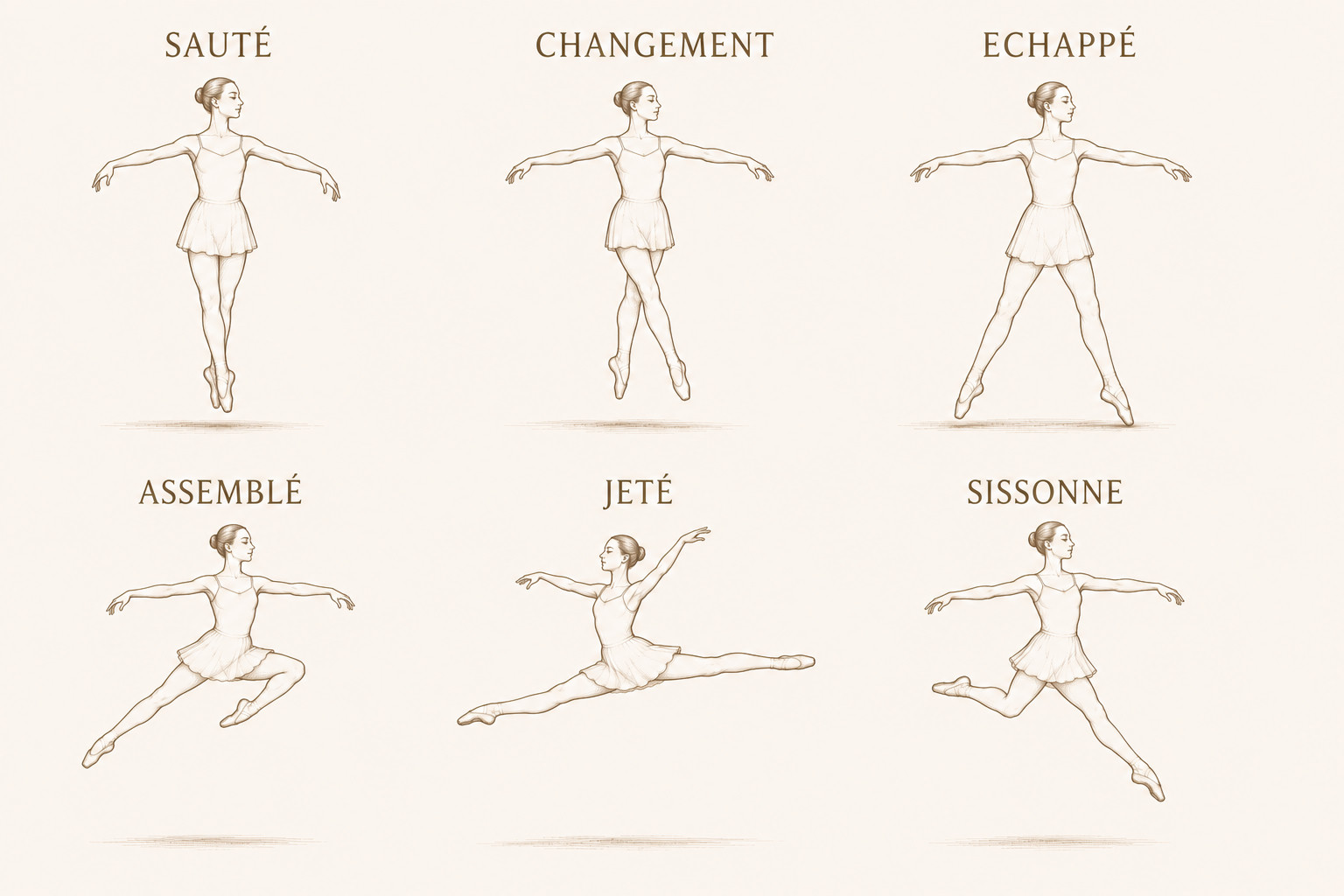
Sauté
Meaning: "Jumped"
Any jump that begins and ends in the same position. The dancer springs into the air from both feet and lands on both feet. Proper pliés before takeoff and upon landing are essential. Sautés can be performed in first, second, or fifth position.
Changement
Meaning: "Change"
A jump beginning in fifth position where the feet change positions in the air, landing with the opposite foot in front. The legs should beat together at the height of the jump before changing. This develops quick footwork and coordination.
Échappé
Meaning: "Escaped"
Beginning in fifth position, the dancer springs into the air and lands in second or fourth position. The feet literally "escape" from the closed fifth position. Échappés can also be performed as relevés without the jump.
Assemblé
Meaning: "Assembled"
A traveling jump where one leg brushes out while pushing off the supporting leg. Both legs come together ("assemble") in the air, and the dancer lands on both feet in fifth position. The assemblé demonstrates coordination and the ability to travel through space.
Jeté
Meaning: "Thrown"
A jump from one foot to the other where the working leg appears to be thrown into the air. Petit jeté is a small jump, while grand jeté is a large leap with the legs in a split position at the peak. The grand jeté is one of ballet's most spectacular movements.
Sissonne
Meaning: "Named after its creator"
A jump from two feet to one foot. The dancer springs from fifth position and lands on one leg with the other extended in any direction. Sissonne fermée closes in fifth, while sissonne ouverte remains open. This jump requires excellent balance and control.
Turns (Pirouettes)

Pirouette en Dehors
Meaning: "Turn outward"
A turn away from the supporting leg. For example, when standing on the right leg, the turn rotates to the right. The working foot is typically held at the knee in retiré position. En dehors turns are generally considered easier than en dedans.
Pirouette en Dedans
Meaning: "Turn inward"
A turn toward the supporting leg. When standing on the right leg, the turn rotates to the left. These turns are more challenging as they move toward the working leg. They require excellent balance and core strength.
Chaînés (Chaînés Déboulés)
Meaning: "Chains"
A series of quick half-turns executed one after the other, traveling in a straight line or circle. Each turn is a half rotation, creating a continuous spinning motion. The dancer maintains relevé throughout and the turns should be smooth and connected like links in a chain.
Fouetté
Meaning: "Whipped"
A spectacular turning step where the working leg "whips" around to the side and back to retiré with each rotation. The most famous example is the 32 fouettés in Swan Lake, a technical tour de force. The whipping motion of the leg generates momentum for each turn.
Essential Technical Concepts
En Croix
Meaning: "In the shape of a cross"
A sequence of movements performed to the front (devant), side (à la seconde), back (derrière), and side again. This pattern is fundamental to ballet training and appears in many barre exercises.
Épaulement
Meaning: "Shouldering"
The placement of the shoulders in relation to the head and body, creating three-dimensional positions. Proper épaulement gives classical ballet its characteristic elegance and allows the dancer to face various directions while maintaining beautiful lines.
Aplomb
Meaning: "Perpendicularity"
The dancer's stability and balance, the ability to hold positions with perfect equilibrium. Aplomb requires proper alignment from head to toe and is essential for all advanced technique, especially turns and balances.
Ballon
Meaning: "Balloon"
The light, elastic quality in jumping that makes the dancer appear to pause at the height of the jump before descending. Great ballon creates the illusion of floating or bouncing effortlessly through the air.
En Pointe
Meaning: "On the point"
Dancing on the tips of the toes in specially constructed pointe shoes. This technique, primarily for women, creates an ethereal quality and extended lines. Dancers typically begin pointe work after years of training when the feet and ankles are strong enough.
Allegro & Adagio
Allegro refers to fast, energetic movements and jumps. Adagio refers to slow, sustained movements that emphasize control, balance, and grace. Both are essential components of ballet class and performance, developing different aspects of technique.
Understanding Ballet Technique
Ballet technique is built on principles that have been refined over centuries. Each position and step serves a specific purpose in developing strength, flexibility, musicality, and artistry. The seemingly simple movements practiced at the barre form the foundation for the spectacular jumps and turns seen on stage.
For Dance Students: Mastering these fundamentals takes years of dedicated practice. Focus on quality over quantity- a well-executed tendu is more valuable than attempting advanced steps before you're ready. Always work within your current level of strength and flexibility to prevent injury.
For Ballet Enthusiasts: Understanding these technical elements deepens appreciation for ballet performances. When you watch a professional dancer execute 32 fouettés or soar through a grand jeté, you're witnessing the culmination of countless hours perfecting these fundamental movements.
Remember: every prima ballerina and principal dancer began with these same basic positions. The beauty of ballet lies not just in spectacular virtuosity, but in the purity and precision of its foundational technique.