Ballet Positions - Fundamental Ballet Techniques Part 1
Explore the fundamental building blocks of classical ballet. From the five basic positions established by Pierre Beauchamp in the 17th century to the elegant port de bras that frames every movement, discover the foundational positions that every dancer must master. These positions form the alphabet of ballet, the essential vocabulary from which all movement springs.
The Five Basic Positions of the Feet
All classical ballet begins with these five fundamental positions, codified by Pierre Beauchamp, the dancing master of King Louis XIV. These positions form the foundation of every ballet movement and are the first skills taught to beginning dancers.
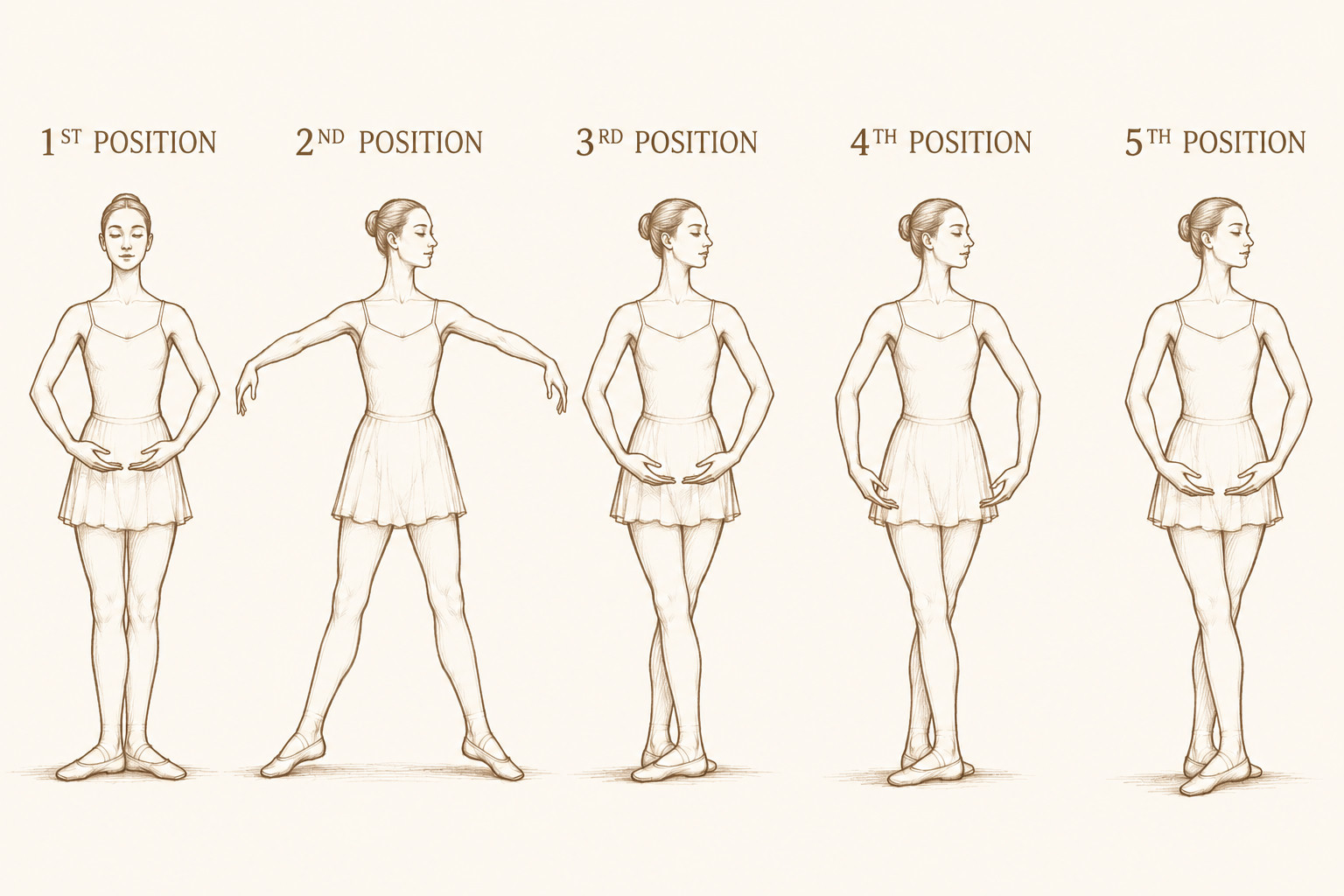
First Position
Feet: Heels touch together with toes turned out to form a straight line. The weight is evenly distributed between both feet.
Purpose: First position teaches the dancer to turn out from the hips while maintaining balance and proper alignment. It's used as a starting and ending position for many exercises.
Key Points: Knees should be straight, weight centered over the balls of the feet, and turnout should come from the hips, not forced through the feet or knees.
Second Position
Feet: Same turnout as first position, but the feet are separated by approximately one foot's length. The line from heel to heel remains straight.
Purpose: Second position provides a wider base of support and is essential for sideways movements. It develops strength in the turned-out position.
Key Points: The distance between feet should not be so wide that it compromises stability. Weight should remain centered between both feet.
Third Position
Feet: One foot is placed in front of the other with the heel of the front foot touching the middle of the back foot. Both feet remain fully turned out.
Purpose: Third position is often used as a preparatory position for beginners before advancing to fifth position. It builds the strength needed for proper turnout.
Key Points: This position is less commonly used in professional ballet but is valuable for students developing their technique.
Fourth Position
Feet: One foot is placed directly in front of the other, separated by approximately one foot's length. It's like first position, but with the feet apart.
Purpose: Fourth position prepares dancers for pirouettes and develops balance. It's considered one of the most challenging positions to master.
Key Points: The heel of the front foot should align with the toe of the back foot. Weight distribution is crucial for maintaining balance and executing turns.
Fifth Position
Feet: One foot is placed directly in front of the other with the heel of the front foot touching the toe of the back foot. Both feet are fully crossed and turned out.
Purpose: Fifth position is the most used position in classical ballet. It provides the tightest, most secure base for jumps, turns, and transitions.
Key Points: Requires significant flexibility and turnout. The feet should be completely crossed with no gap between them. This position exemplifies the precision of classical technique.
Port de Bras - Positions of the Arms
Port de bras, meaning "carriage of the arms," refers to both the arm positions and the movement of the arms between positions. Different ballet methods (Vaganova, Cecchetti, RAD) have slightly different numbering systems, but the fundamental positions remain similar.
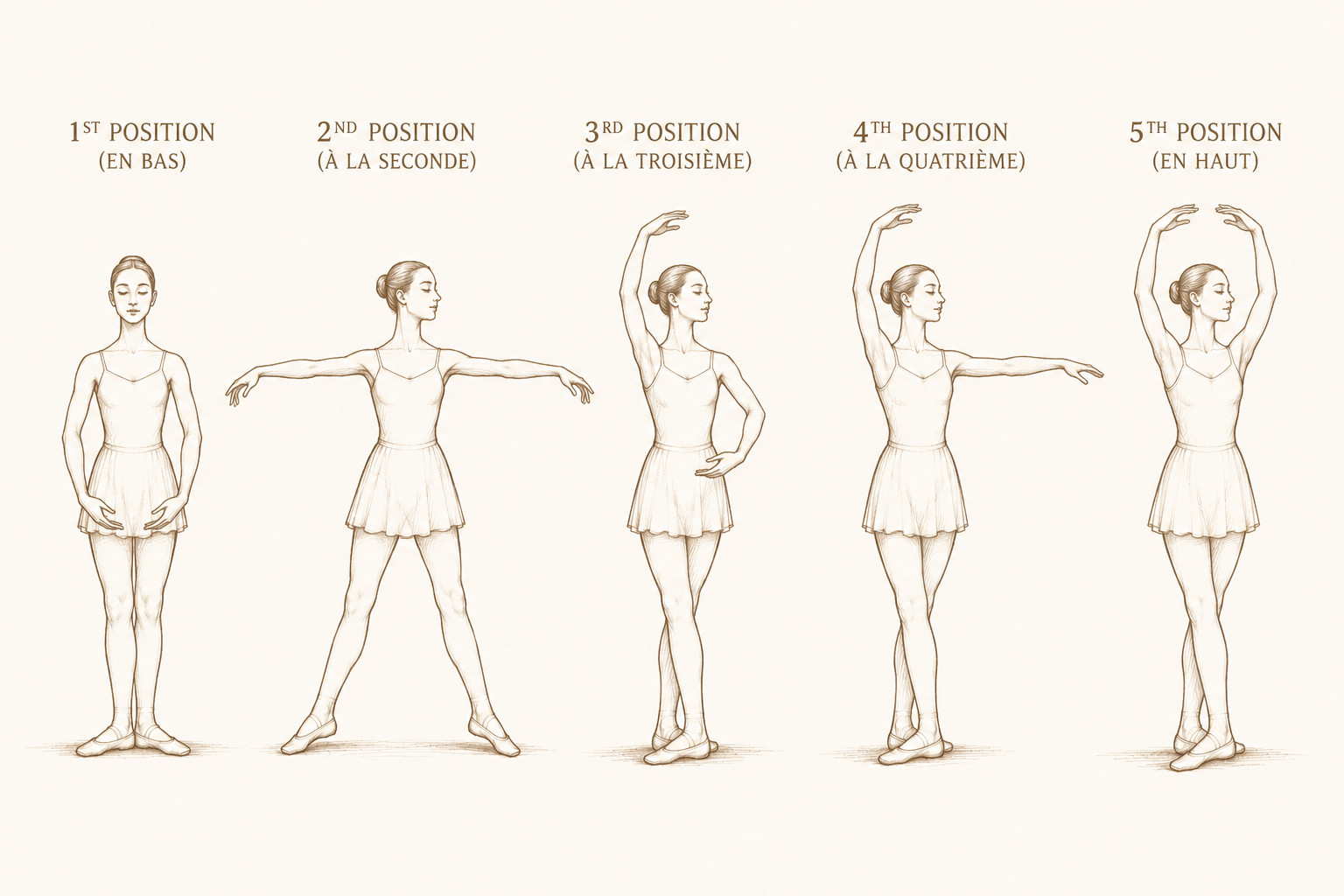
Bras Bas (Preparatory Position)
Arms form a soft oval shape in front of the body, with hands held low near the thighs. The elbows are gently curved, and the fingers are softly grouped. This is the starting position for most arm movements and creates an elegant frame for the dancer's body.
First Position
Arms maintain the oval shape but are raised to approximately waist or stomach level. The arms should appear to be embracing a large beach ball. This position is used in many basic combinations and helps dancers develop proper shoulder placement.
Second Position
Arms are extended to the sides, slightly forward of the shoulders, with a gentle curve from shoulder to fingertip. The arms should be held at approximately shoulder height with elbows slightly below shoulder level. This creates long, graceful lines and is essential for many classical variations.
Third Position (Vaganova)
One arm remains in second position while the other is raised above the head in a curved position. This asymmetrical position creates beautiful lines and is frequently used in adagio work and variations.
Fifth Position (High Fifth)
Both arms are raised above the head in a curved, oval shape. The hands should be visible in the peripheral vision. This position requires great strength and control, as the shoulders must remain down while the arms are elevated. It's the culmination of proper port de bras training.