✦ Origins and Historical Context ✦
Serenade holds a unique place in ballet history as the first work George Balanchine created in America. In 1934, Balanchine and the impresario Lincoln Kirstein had recently co-founded the School of American Ballet in New York, with the ambition of establishing a genuine American classical ballet tradition. Serenade was created as a teaching exercise for the school's students - a practical demonstration of how Balanchine worked, set to Tchaikovsky's Serenade for Strings in C major.
The circumstances of its creation are woven into the fabric of the ballet itself. Balanchine famously incorporated accidents and absences into the choreography: when a student arrived late to rehearsal, he choreographed her entrance into the work; when another fell during practice, he kept the fall; when a dancer began to weep, he built a moment of sorrow around her tears. The ballet thus carries within it a kind of living record of its own birth.
The work received its first public performance on June 10, 1934, on an outdoor stage at the Warburg estate in White Plains, New York. It was performed by candlelight, giving it from the very beginning its characteristic atmosphere of nocturnal mystery. Balanchine continued to refine and revise the ballet over subsequent decades, and the version performed today reflects his final intentions for the work.
♫ The Music ♫
Tchaikovsky composed his Serenade for Strings in C major in 1880, describing it as an homage to Mozart - a desire to write in the spirit of the classical string serenade. The work is in four movements: a solemn Pezzo in forma di sonatina, a fleet and delightful Waltz, an elegiac Élégie, and a finale built on Russian folk themes. It is among Tchaikovsky's most beloved orchestral works, radiant with melody and warmth.
Balanchine did not use the movements in their original order. He placed the deeply felt Élégie last, giving the ballet its characteristic ending on a note of quiet, aching beauty rather than the vigour of the folk-inflected finale. This single rearrangement profoundly shapes the emotional arc of the work, drawing the audience from the ceremonial and the playful into something more mysterious and sorrowful.
Balanchine's relationship with Tchaikovsky's music was lifelong and deeply personal - he regarded the composer as a kindred spirit. Serenade was the first of many works he would set to Tchaikovsky, a body of collaboration that would eventually include The Nutcracker, Swan Lake, and the great late masterwork Mozartiana.
📖 The Work 📖
Serenade has no narrative in the traditional sense. Balanchine famously resisted attempts to impose a story upon it, insisting that the ballet was simply the music made visible. And yet the work is far from abstract - it moves with the emotional logic of a dream, and audiences consistently find in it themes of longing, fate, loss, and transcendence, even without named characters or a declared plot.
Movement I - Sonatina
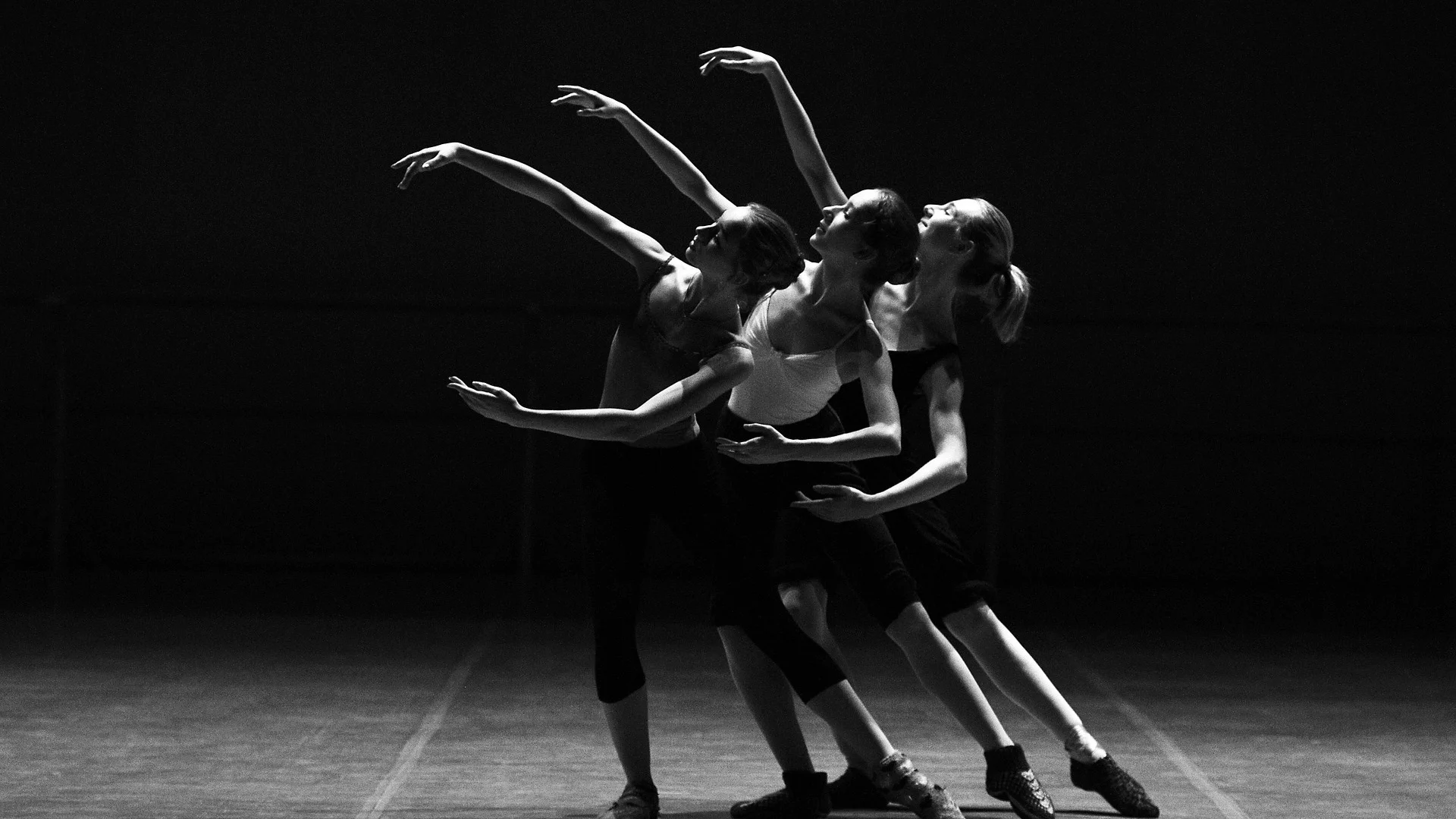
The ballet opens with one of the most celebrated images in all of dance. Seventeen women stand in a diagonal shaft of light, their right arms raised, palms facing outward - a gesture simultaneously of greeting and of warding off. They stand completely still as the music begins its stately introduction. Then, with a slow turn of the wrist, they come to life.
What follows is a meditation on the corps de ballet itself - on the relationship between the individual dancer and the group, and on the patterns and geometries that emerge when bodies move together in space. Balanchine deploys his seventeen women with extraordinary invention, the formations shifting and dissolving in perfect accord with the architecture of Tchaikovsky's opening movement.
Movement II - Waltz
The Waltz brings a change of atmosphere - lighter, more playful, more overtly classical. The women are joined for the first time by male dancers, and the ballet takes on a more social, even ballroom quality, though Balanchine's invention ensures that nothing ever becomes conventional or predictable.
Individual women begin to emerge from the ensemble, and the first hints of a more personal drama begin to surface. A woman arrives late, running to join the others - that originally accidental lateness now given permanent form in the choreography. A man enters and moves through the women as if searching for someone. The emotional temperature begins to rise beneath the Waltz's polished surface.
Movement III - Russian Theme
The folk-inflected Russian Theme introduces a more earthy, grounded energy into the ballet. The driving rhythms of the music propel the dancers into more vigorous, sweeping movement. There is joy here, but also a sense of gathering intensity - the feeling that something significant is approaching.
A pas de deux emerges, and with it comes a moment of conflict - a second woman arrives and leads the man away from the first. The gestures of love and loss that have been hinted at throughout the ballet now become more legible, though Balanchine never reduces them to simple narrative. The meaning remains open, felt rather than stated.
Movement IV - Élégie
The Élégie is the emotional heart and culmination of the ballet. A single woman lies on the ground as the music begins its long, arching melody. A man kneels beside her. Other women gather around them, their slow, sweeping movements suggesting mourning, consolation, and something beyond - a passage into another realm.
The ending is among the most mysterious and moving in all of ballet. The woman is lifted and carried off into the darkness by a group of her companions, while other dancers kneel or reach upward. Whether this figures death, transformation, transcendence, or simply the end of music, Balanchine never said - and the ambiguity is precisely the point. The ballet concludes with the same diagonal of women with which it began, their raised palms once more turning in the fading light.
👑 Themes and Imagery 👑
The Late Arrival
A dancer who runs on to join the others, born of a real rehearsal accident. She has come to embody themes of fate, chance, and the individual finding their place within a greater whole.
The Woman Who Falls
Another accident made permanent - a dancer who stumbles and falls during rehearsal, her moment of vulnerability preserved forever in the choreography as an image of human fragility.
The Dark Angel
In the Élégie, a woman covers the eyes of a kneeling man and draws him away from the woman he loves. She is often read as a figure of fate or death - one of ballet's most haunting personifications of the inevitable.
Moonlight
The ballet's signature blue-white lighting and flowing blue costumes create a pervasive atmosphere of nocturnal mystery - Serenade is, above all, a ballet that takes place in moonlight, in the realm between waking and dream.
⭐ Impact and Legacy ⭐
Serenade began as a class exercise. Balanchine, newly arrived in America and running his own School of American Ballet, choreographed it on his students to teach them stage technique, and its first performance took place outdoors on the Felix M. Warburg estate in White Plains, New York, on June 10, 1934. The class that night happened to have seventeen women and no men, which is why the ballet opens on seventeen women standing in formation rather than with a conventional entrance.
Balanchine wrote real rehearsal accidents into the finished choreography rather than editing them out. When one student fell during a rehearsal, he kept the fall in the ballet; when another arrived late to class one day, he built her breathless late entrance into the choreography as well, moments that remain in the Elegy section as staged today.
The ballet's public premiere came later, on March 1, 1935, at the Adelphi Theatre in New York, danced by the American Ballet - the professional company Balanchine and Lincoln Kirstein had just formed. Balanchine set the piece to Tchaikovsky's Serenade for Strings in C, Op. 48 (1880), a concert work never intended for the stage, and reversed the order of its final two movements, ending the ballet with the Elegy rather than the more upbeat Russian Dance that closes Tchaikovsky's score - a change that leaves the ballet finishing on a note of loss rather than resolution.