✦ Origins and Historical Context ✦
Apollo - originally titled Apollon Musagète, meaning Apollo, Leader of the Muses - premiered on June 12, 1928, at the Théâtre Sarah Bernhardt in Paris, performed by Sergei Diaghilev's Ballets Russes. The ballet was commissioned by the Library of Congress in Washington, D.C., making it one of the few Ballets Russes works to have an American patron, and it received its world premiere in Washington two months earlier, on April 27, 1928.
The collaboration between the twenty-four-year-old George Balanchine and the already celebrated Igor Stravinsky marked the beginning of one of the most important partnerships in the history of the arts. Balanchine had recently joined Diaghilev's company as its resident choreographer, and Stravinsky, though already famous for The Firebird, Petrushka, and The Rite of Spring, was now embracing a cooler, more restrained neoclassical style. Apollo was the perfect meeting point for both artists.
The subject - the young god Apollo receiving instruction from three Muses - gave Balanchine the opportunity to do something that would define his entire career: strip ballet down to its essentials. Rejecting elaborate narrative, exotic scenery, and theatrical spectacle, he created a work of pure classical movement in which dance itself became the drama. Balanchine later described Apollo as the turning point at which he understood that constraints and limitations were not obstacles to creativity but its very source.
♫ The Music ♫
Stravinsky composed the score for string orchestra alone - an unusually spare and refined choice that perfectly matches the ballet's aesthetic of disciplined elegance. The music belongs to Stravinsky's neoclassical period, drawing consciously on the styles of Lully, Handel, and Bach while remaining unmistakably Stravinsky in its rhythmic inventiveness and harmonic sharpness.
The score is structured as a series of variations and solos for the four principal figures - Apollo and his three Muses - culminating in a grand pas de deux for Apollo and Terpsichore and a final apotheosis. Throughout, the music has a luminous, unhurried quality, its clear melodic lines and steady pulse creating an atmosphere of calm authority that mirrors Apollo's journey from raw divinity to serene mastery.
Stravinsky himself revised the score several times and approved Balanchine's later decision to drop the prologue scene of Apollo's birth, beginning the ballet instead with the already-grown young god. The version performed today almost always follows this revised, more concentrated form, which opens directly with the arrival of the Muses and runs to approximately thirty minutes.
📖 The Story 📖
Prologue - The Birth of Apollo
In the original 1928 version, the ballet opens on the island of Delos. Leto, pregnant by Zeus, is attended by two handmaidens. She gives birth to Apollo - the god of light, music, and poetry - and the infant is immediately swaddled and presented with a lute. The scene is brief and ritualistic, establishing the divine nature of what is to follow. As noted above, this prologue is frequently omitted in modern productions, with the ballet beginning directly at the point where Apollo is a young man, still raw and untested, but already possessed of latent greatness.
Apollo and the Three Muses
The young Apollo stands alone, ungainly and unformed. He holds a lute, the symbol of his domain, but he does not yet know how to use it. Three Muses descend to instruct him: Calliope, Muse of poetry and eloquence; Polyhymnia, Muse of mime and sacred song; and Terpsichore, Muse of dance and choral song.
Each Muse presents herself to Apollo in a solo variation that defines her particular art. Calliope dances with a tablet, her movement lyrical and literary in quality, embodying the sweep and structure of poetic thought. Polyhymnia dances with a finger pressed to her lips - the gesture of mime, of meaning conveyed without words - her solo precise and silently expressive. Terpsichore's variation is the most purely musical, her movement flowing with the string orchestra in a way that makes dance and music feel like the same thing.
Apollo watches each Muse in turn, and through their instruction, he begins to find his own authority. He dances with each of them, and in each encounter something in him awakens and clarifies. The famous pas de deux with Terpsichore is the emotional and choreographic heart of the ballet - in it, Apollo recognises in dance the art that most perfectly expresses the divine order he is coming to understand. Terpsichore becomes his chosen Muse.
The Coda and Apotheosis
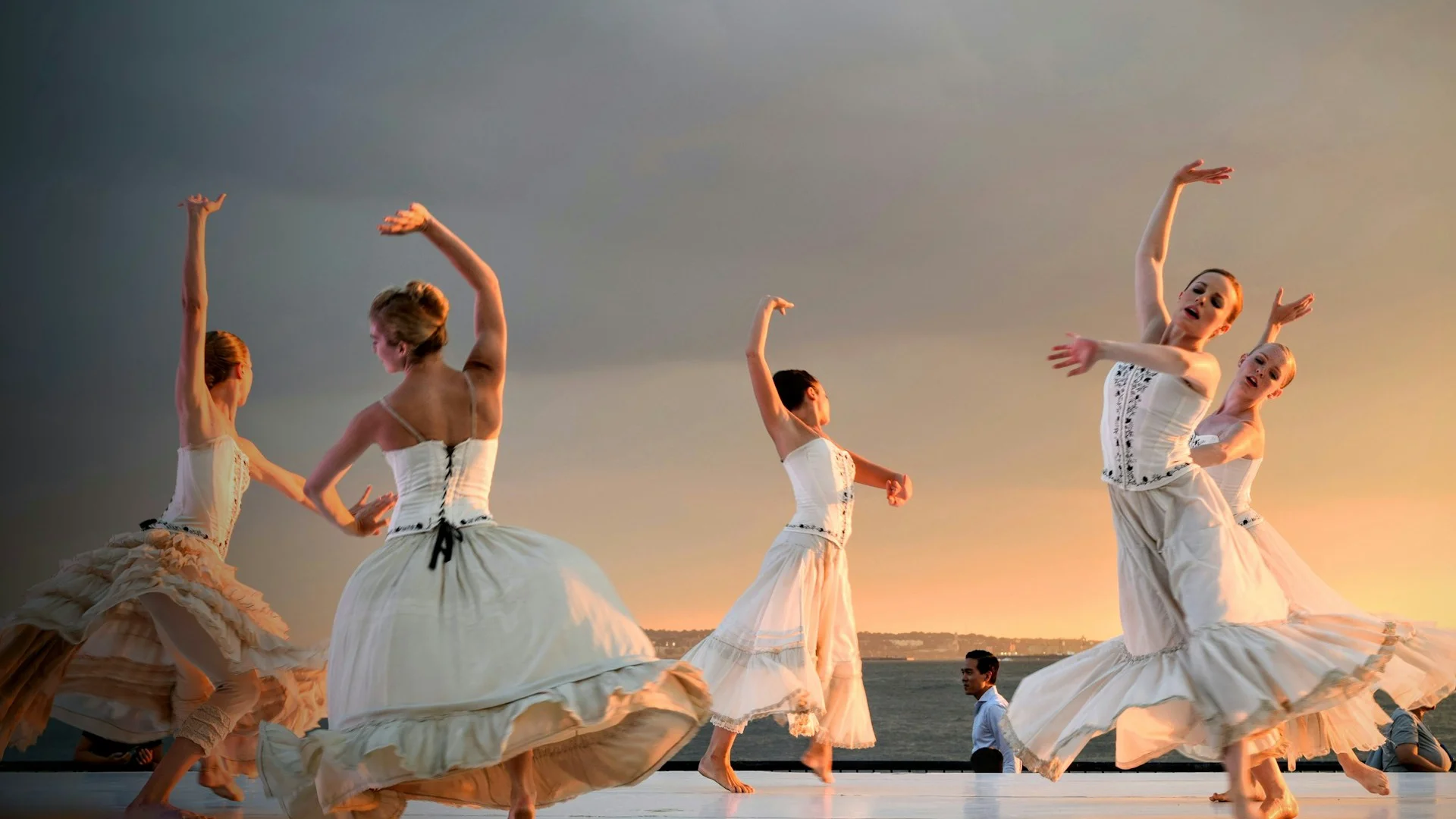
The ballet moves towards its celebrated final image in the coda, which brings all four figures together. The three Muses place their hands on Apollo's shoulders in a sunburst formation as he stretches forward and upward, the embodiment of aspiration towards perfection and light.
In the apotheosis, a chariot descends from Mount Parnassus. Apollo mounts it and begins his ascent towards Olympus, the three Muses streaming behind him in a trailing procession, their arms extended towards the heavens. The scene is one of extraordinary serenity - not triumphant in a martial sense, but radiant, inevitable, complete. The god has found himself. Art has found its purpose.
The ballet ends not with applause-seeking spectacle but with a stillness that feels genuinely sacred. It is one of the most quietly powerful endings in the repertoire.
👑 Character Development 👑
Apollo
At the outset ungainly and unformed, Apollo undergoes a journey of artistic and spiritual awakening across the ballet's short duration. By the apotheosis he has become the serene, luminous god of light and art - his transformation achieved not through conflict but through learning and receptivity.
Terpsichore
Muse of dance and the art closest to Apollo's heart. Her solo and pas de deux with Apollo represent the apex of the ballet - she is his chosen companion and the embodiment of the idea that dance is the highest expression of divine order.
Calliope
Muse of poetry and eloquence. Her variation is lyrical and expansive, evoking the rhythms and structures of verse. She represents the power of language to order and illuminate experience.
Polyhymnia
Muse of mime and sacred song. She dances with a finger to her lips - the art of meaning conveyed in silence. Her precise, contained solo is a study in the expressive power of restraint.
⭐ Impact and Legacy ⭐
Stravinsky's score was commissioned by the Elizabeth Sprague Coolidge Foundation for $1,000 and received its actual world premiere six weeks before the Paris opening, on April 27, 1928, at the Library of Congress in Washington, D.C., choreographed by and starring Adolph Bolm rather than Balanchine. Diaghilev then acquired the ballet for the Ballets Russes and handed it to the 24-year-old Balanchine, whose version opened at the Théâtre Sarah-Bernhardt in Paris on June 12, 1928, with Serge Lifar as Apollo, Alexandra Danilova and Alice Nikitina alternating as Terpsichore, Lubov Tchernicheva as Polyhymnia, and Felia Dubrovska as Calliope.
Balanchine kept reworking the ballet for decades. He shortened its title from Apollon Musagète to Apollo in the 1950s, and in 1979, staging it on Mikhail Baryshnikov, he cut the opening scene depicting Apollo's birth and replaced the god's original ascent up a staircase to Mount Parnassus with a closing tableau of the three Muses in ascending arabesques beside him. New York City Ballet has performed that pared-down version ever since, while other companies - including Suzanne Farrell's troupe, in either 2001 or 2010 depending on the source - have restored the birth prologue Balanchine cut.
Apollo opened a collaboration between Stravinsky and Balanchine that continued for roughly four decades and produced more than two dozen further works together, including Orpheus (1948) and Agon (1957), an unusually long-running partnership between a single composer and choreographer in ballet history.